 Resources:
Music, MIDI & Text Resources:
Music, MIDI & Text
= Files for You to
Download =
|
Magazine
Interviews, Plus (PDF Files)
New:
At Last! For several
years I've been trying to find a simpler,
convenient way to create and post online several
magazine articles and interviews that belong here
as additional resources. I was granted the
permission by several interviewers and editors to
create web versions of some of my own "classic"
interviews. But the chore of scanning each page
and then using OSR conversion software to come up
with text files, and finally interposing higher
res images for the photos, graphs, scores and
diagrams similar to the original pages, made the
task look punishing indeed. Or at any rate, it
would have taken far more time and effort than I
could afford to spend on the venture. Also, while
interposing original images with new html text
does give an idea of the original layout, there's
nothing quite like seeing the actual pages of the
magazine themselves, is there, especially when the
images are all cleaned and tweaked to look "better
than new?"
So here's what
we've got for you, to read in your browser
directly, or download for printing and saving. The
most requested files have been for the classic
Keyboard and other magazine interviews. Okay, to
start with, how about the pair of Keyboard Magazine interviews Bob Moog did
with me, right after completing my score to TRON?
Then there's a fine interview with Jim Aikin for a
new short-lived magazine on computers for music
making, the topic being those very timely issues.
And one for FilmScore Monthly, about (surprise) most of
my filmscore work.
For something
completely different, we include three fascinating
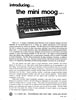
bonuses. The first is the original 1970 brochure
for the popular often-copied Mini Moog. The second
is an article from the early 50s about a
do-it-yourself project which inspired
the Circon some 25 years later...! I
couldn't resist including on page 6 of it a
pleasantly sentimental painting, which reminds me
of my grandfathers, the way they would nod off
while reading. (You'll also note that our page on the Circon now includes
scans and a description of Bob Moog's original
schematic and letter.) The third bonus is a very rare early 1964 interview
with George Wright, the pipe organ legend who also inspired me
early on.
This issue of Bombarde magazine (copyright 1964
ATOE/ATOS) is in great demand at
high prices. I lucked into a decent copy quite
reasonably recently, then tried to make it look
like new in the pdf scans. (More information about
the issue and ATOS HERE.)
And don't
forget we have several other in-depth interviews
(with Connor Freff Cochran, Carol Wright, and
others) available here, in the text section of
this resource page. Finally, please note
that these PDF files, while highly efficient,
contain a lot of information, so are between 1 to
2.5 megs in size each. If you have a slower
connection, give them a while to load, thanx!)
(Note: for downloading
or direct viewing options, check the
instructions for your particular browser. Some
browsers default to the former, others to the
latter, but most generally permit either
on-screen reading, for speed, or downloading, to
read and/or print offline later.)
|
|
Vintage
Wendy Carlos Interviews
|
|
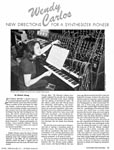
"New Directions for a
Synthesizer Pioneer"
by Robert Moog
Keyboard
Magazine Cover Story A,
November 1982
|
|
Download
and/or read this article.
If you
have problems download this zip
file.
|
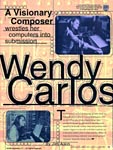
"Visionary Composer and
Computers"
by Jim Aikin
Music and
Computers Magazine,
Nov/Dec 1997
|
|
Download
and/or read this article.
If you
have problems download this zip
file.
You may
also enjoy reading the full
transcript
of this interview HERE
|
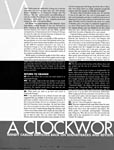
"A Clockwork Composer"
by Jeff Bond
FilmScore
Monthly Magazine,
March 1999
|
|
Download
and/or read this article.
If you
have problems download this zip
file.
|
"Wendy's World"
A new text/video interview with
Frank Oteri
New Music
Box cover story,
April 2007
|

|
More
about the interview HERE.
Watch
the Video or read the full
text at New
Music Box -- HERE.
Read
our concise online edition of
the interview in html -- HERE.
|
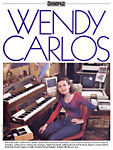
"Defying Conventions,
Discovering New Worlds"
by Dominic Milano
Keyboard
Magazine Feature Story
Part 1, November 1986
|
|
Download
and/or read this article.
If you
have problems download this zip
file.
(Read the
new, brief Looking Back
comments
about the four '86 articles.)
|
"Soundpage Exhibits from the
Butterfly Collection"
by Dominic Milano
Keyboard
Magazine Feature Story
Part 2, November 1986
|
|
Download
and/or read this article.
If you have
problems download this zip file.
Listen to
Track 1 mpg3
Listen to
Track 2 mpg3
Listen to
Track 3 mpg3
Listen to
Track 4 mpg3
Listen to
Track 5 mpg3
|
"A Guided Tour of Beauty in
the Beast"
and
"A Many-Colored Jungle of Exotic
Tunings"
both by Dominic Milano
Keyboard
Magazine Feature Story
Parts 3 & 4, November 1986
|
|
Download
and/or read Guided Tour.
If you have
problems download this zip file.
Download
and/or read Exotic Tunings.
If you
have problems download this zip
file.
|
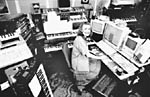
"Wendy Carlos: In the Moog"
by Chuck Miller
Goldmine
Magazine Feature Story
January 2004
|
|
Download
and/or read this article.
If you have
problems download this zip file.
|
|
|
Other PDFs
from the archives
|
|
|
"Introducing the Mini Moog"
R. A Moog
Company brochure
Copyright 1970
|
|
Download
and/or read this brochure.
If you
have problems download this zip
file.
|
"Tomorrow's Electronic
Barbershop Quartet"
by L. A. Meacham
Popular
Mechanics Magazine,
January 1952
(Copyright
1952 Pop Mech)
|
|
Download
and/or read this article.
If you
have problems download this zip
file.
|
"Very Rare George Wright
1964 Interview"
by Stu Green
Bombarde
Magazine,
February 1964
(Copyright
1964 ATOE)
|
|
Download
and/or read this article.
If you
have problems download this zip
file.
|
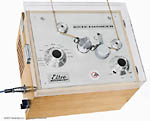
"The ISI Eltro
Information Rate Changer"
Original
1967 Gotham Audio
brochure by Stephen Temmer
|
|
Download
and/or read this article.
If you
have problems download this zip
file.
|
|
|
###
|
|
Note: All extant
copyright restrictions apply for the original
articles, in addition to those for our newly
created pdf versions.
Also, don't forget
there are other vintage interviews and texts
available in
standard non-pdf format below.
Text and pdf files ©
1998-2012 Serendip LLC. No images, text, graphics
or design may be reproduced without permission.
All Rights Reserved.
|
 (Top
of the Page)
(Top
of the Page)
 Music
and MIDI files Music
and MIDI files
Secrets
revealed: Discover the inside skinny of
using and editing the Theremin-like "Circon" (or
other novel similar devices) under MIDI control!
Download images of the tracks overview and Circon
Solo track close-ups , plus the full MIDI files
from Wendy's "HeavenScent", as heard on "Tales
of Heaven and Hell". We've got more than the
usual information for you, all on its own
HeavenScent Page
(Info & Downloads).
Take a look!
New:
Just found score page: While trying to
locate something quite different, I came upon my
original Finale score page created during the
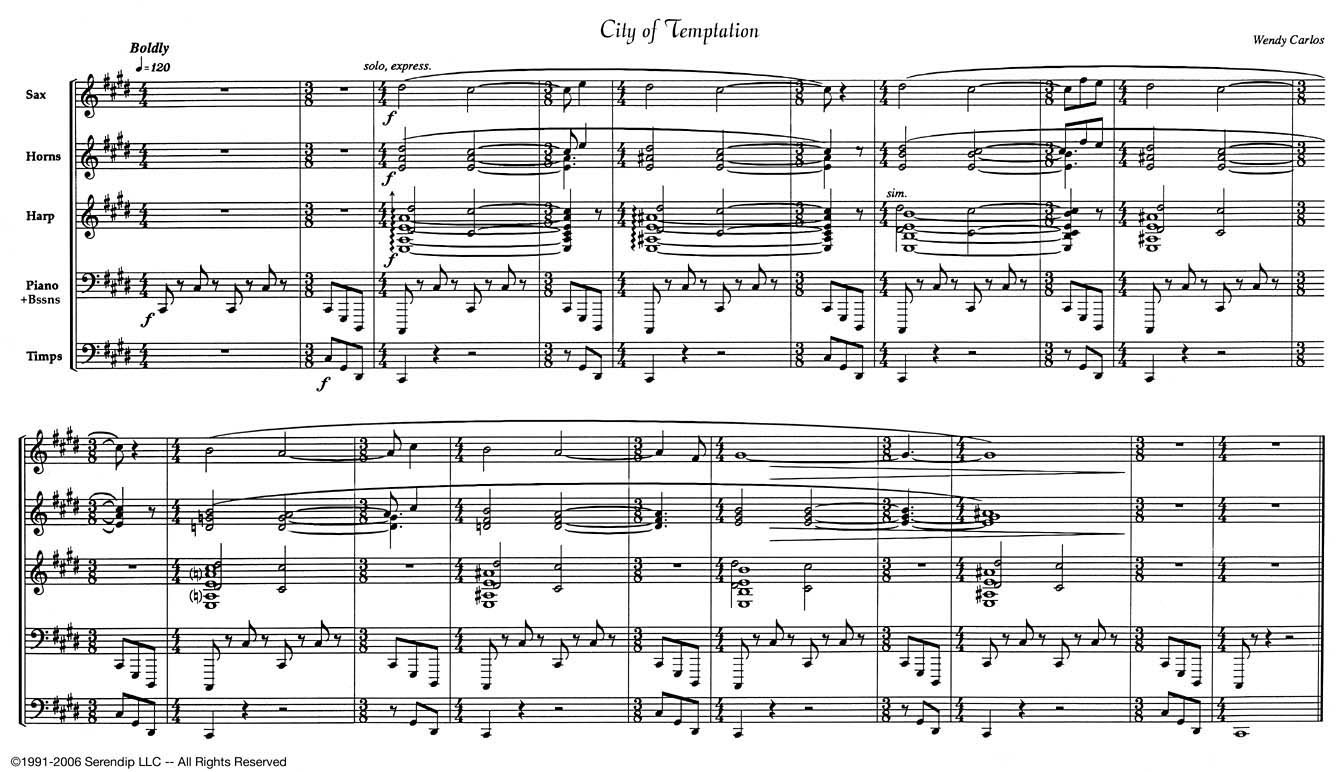
initial composition of "City of Temptation",
a featured track on "Tales of Heaven and
Hell".
It's one of the rare examples of music written in 11/8
meter, which gives it that notable "push" into each
new bar. Actually, it turned out to be more helpful
to lay it out in the equivalent 4/4 + 3/8
meter pairs for each two adjoining bars, but the
sound is eleven beats. It resembles the action music
in my score to TRON, which breaks the seven
beats into 4 + 3 each 7/8 bar, with
a similar asymmetrical effect. The structure is very
formal, how the melodic and harmonic lines progress,
and the ostinato of the bass lines. Thought you'd
enjoy a look-see...!
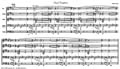
City of Temptation
(click for full size
scan).
DigiPerformer 1.6+/ Performer 5.1+ Format or Standard MIDI Format or .ZIP version of MIDI
format
file of the music tracks used on S-OB 2000
's Air on a G-String.
DigiPerformer 1.6+/ Performer 5.1+ Format or Standard MIDI Format or .ZIP version of MIDI format file of the music tracks
used on S-OB 2000 's Two
Part Invention in d minor.
These are Wendy's
actual final performances from the Telarc CD for
you to study or to try your own realization using
your own sequencer and MIDI gear. Have fun! (Note:
the standard MIDI format omits track assignments,
some names, and helpful comments data,
unfortunately. But they do contain all the notes
and expression data.)
MIDI

                        arrangements ©1988 Wendy Carlos
DigiPerformer 1.6+/
Performer 5.1+ Format or, if necessary, Older Performer 2.41
Format or
Standard MIDI Format or .ZIP version of MIDI
format
file of the MIDI music tracks for The
Hummingbird from Carnival of the
Animals, Part II.
DigiPerformer 1.6+/ Performer 5.1+ Format or, if necessary, Older Performer 2.41
Format or
Standard MIDI Format or .ZIP version of MIDI
format
file of the MIDI music tracks for The
Vulture from Carnival of the
Animals, Part II.
These are Wendy's
final performances of her original compositions
from the CBS/Sony CD, for you to study or to try
your own realization using your own sequencer and
MIDI gear. Have fun! (Note: the standard MIDI
format omits track assignments, some names, and
helpful comments data, unfortunately. But you get
all the notes, including those oddball tricks with
alternating notes and tracks that many early MIDI
devices required.)
(Weird)
Al Yankovic provided the witty poems and narration
of the original recording, but MIDI format doesn't
currently support spoken humor, alas! Consult the CD for more
details.
Music

                        and MIDI arrangements ©1988 Wendy Carlos
DigiPerformer 1.6+/
Performer 5.1+ Format or, if necessary, Older Performer 2.41
Format or
Standard MIDI Format or .ZIP version of MIDI format file of the MIDI music
tracks for the opening orchestral section from her
parody on Peter and the Wolf, by
Prokofiev, pp. 3-5 of the full score, rehearsal #s:
0 &1.
DigiPerformer 1.6+/
Performer 5.1+ Format or, if necessary, Older Performer 2.41
Format or
Standard MIDI Format or .ZIP version of MIDI format file of the MIDI music
tracks for an early orchestral section from her
parody on Peter and the Wolf, by
Prokofiev, pp. 15-19, rehearsal #s: 11-14.
DigiPerformer 1.6+/
Performer 5.1+ Format or, if necessary, Older Performer 2.41
Format or
Standard MIDI Format or .ZIP version of MIDI format file of the MIDI music
tracks for a large orchestral tutti near the end of
her parody on Peter and the Wolf,
by Prokofiev, pp. 70-78, rehearsal #s: 48-52.
These are Wendy's
final performances from the CBS/Sony CD, for you
to study or to try your own realization using your
own sequencer and MIDI gear. Have fun! (Note: the
standard MIDI format omits track assignments, some
names, and helpful comments data, unfortunately.)
(Weird) Al Yankovic provided the witty
narration of the original recording, but MIDI
format doesn't currently support spoken humor,
alas! Consult the CD for more details.
MIDI

                        arrangements ©1988 Wendy Carlos
DigiPerformer 1.6+/ Performer 5.1+ Format or Standard MIDI Format or .ZIP version of MIDI format file of something rather
unusual: all the notes played during the tuning
of Wendy's Steinway by her lifelong master piano
technician, Norman Yeend. "Norman is simply
the best piano tuner I've encountered. He's exact,
flexible, and really tries to please. And no one
else's tuning method lasts so long, is so durable as
his. I'm lucky to have found him! Lovely man." (If
you ever need one of the sharpest piano technicians
in NYC, you might wish to leave a message on Yeend's
new biz number: (212) 304-1377. Recommended.)
Now you can also
see the way a master tuner "lays the bearings" and
proceeds to tune all 88 keys. By the way, this file
was done without Yeend's being aware of it, using
the simply wonderful Gulbransen
Orchestra II Pro piano MIDI pickup system.
It sits under the keys and has no palpable effect on
the instrument, except that it now becomes an
excellent, flexible MIDI keyboard controller. With
no exaggeration: "it may very likely be the best
MIDI controller in the world, given that your
piano's action is reasonably good to start with...!"
Usage Note: You may
examine or work with the above files for your own
private use only, as all material is copyright
protected, and not in the public domain. You also
may use them for music classroom purposes,
teaching examples, as long these are for
non-profit, provided due credit is given to Wendy
Carlos, and you limit yourself to excerpts only.
Our only request in the case of instructional
usage is that you notify us of your intention via
the Write Wendy mail drop
for our site. Thanks.
|
(Top
of
the Page)
|
Words
& Texts
"Music
and Audio Tool Recommendations"
We regularly
receive questions from the many musicians among
you about what particular tools Wendy uses, and
what she would recommend for others creating
music, scores and audio with digital and computer
tools. If you haven't already seen it, for several
years our site has had some words of praise for
Mark of the Unicorn's respected and powerful MIDI
and Audio editing package, Digital
Performer -- read it HERE. And now we've added a
new page about the powerful mono and stereo audio
editing software, BIAS's Peak, read about
it HERE, and the definitive
library of plug-in and stand alone acoustic
instrumental resources from Garritan Corp., read
about them HERE.
"Only
Human: Touching the Significance"
Here's the most recent soul-searching
interview with Wendy, by the same good Carol Wright
mentioned below. Originally a portion of this
unusually candid, questioning piece was used in the
article "A Simple Thought: Music and Meaning", which
ran in the July 2001 issue of New Age Retailer.
Carol thought it would be intriguing to place
Wendy's pithy observations in the middle of the
article, which otherwise represented a more new age,
spiritual discussion on inspiration and meaning in
art and music. What, Carol wondered, would be the
source of Wendy's inspiration, if she didn't believe
in a God? With a leadoff like that, you know you're
going to discuss a lot of core values -- of music,
creativity, humanity -- and they did.
"The
Digital Phases of Wendy
Carlos"
And here's
a very recent, expansive and
Kaleidoscopic Interview by Carol Wright, written
originally for the Synthmuseum magazine for Spring 2001.
This wide ranging article covers a lot of questions
that many of you have kindly sent to us over several
years now, on the music and tools Carlos has used
over the years. It also discusses the effects of
digital technology on music, and the differences
with the earlier analog instruments. We think you
won't want to miss this one.
"Something
Old, Something New: The Definitive Switched-On"
Here's the first interview with Wendy by Carol Wright,
which took place in the Fall of 1999, for New
Age Voice magazine. Like the title says, this
spontaneous chat delves into topics many of you
still write and ask us about, the Moog years, the
first albums, and now their definitive remastering
and collection into the Switched-On Boxed Set. It's
here and more.
"Tuning
In To Wendy
Carlos"
This witty Cover-Story
article and interview with Wendy by Connor Freff
Cochran, first appeared in Electronic
Musician magazine in November of 1986. In some ways
he got to the real essence of the musician and
person with these candid impressions, as they
discussed the background that went into her "Beauty
in the Beast" album. For those of you who have been
requesting that we post some of the more interesting
past interviews with Wendy on our site, you ought
take a browse at this one before moving on.
"Vocoder
Questions and Answers"
For those of you
fascinated with the sound of the Vocoder, read these
questions and answers by Wendy about her
pioneering "singing" use of this speech-encoding
invention, originally developed in the late '30's
and early '40's by Homer Dudley at Bell Laboratories
(speech encoding? -- where else BUT the
original Bell Labs?!) You may also want to look
again at our view with new caption in
this 1979 photo of the original modular vocoder at the top
of the final Moog Synthesizer. This is the same
vocoder that was used on the soundtrack of Kubrick's
A
Clockwork Orange, and Carlos's TimeSteps. (Note: Beauty
in the Beast and Tales
of Heaven & Hell both use a much newer
Synton SPX 216.)
"The
Original Notes to S-OB 2000"
MacWrite Pro Format (original, complete) or Word 5 Format (complete) or Plain Text Format (missing footnotes and
formatting) file of the booklet's liner notes for
Switched-On Bach 2000, released by Telarc in May
of 1992. These are detailed notes and narratives,
with historical, musical, technical, and
behind-the-scenes information about the way the 1968
S-OB came to be, right through this special
25th Anniversary Version, with Bach's own tunings.
A "must read" if you've not seen them before! For
even more information on the Moog albums of Bach
and Baroque music, particularly about the Moog
Synthesizer itself, check out the Switched-On
Boxed Set, released in the Fall of 1999 on ESD.
A review of Beauty
in the Beast, the album Wendy considers the single most
important of all her work thus far. It was written
by Rob Berry, for the Ambient FAQ. (Now you can get a
beautifully remastered CD edition on
ESD.)
Here's another review of Beauty
in the Beast, this imaginative, enthusiastic short one is
by Jim Aikin. It first appeared in Keyboard magazine, and was among the
initial raves that the album received, right after
it was released on Audion for all too brief a time,
in 1987. (Now you can get a beautifully remastered CD edition on ESD.)
We just found this full
original transcript of a featured Jim Aikin
Interview with Wendy that appeared in the Nov-Dec
1997 issue of Music & Computers magazine, now
long gone, alas. (A much shorter edited and printed
version is also available in our collection of pdf
files,
created from page scans of the original
publications.) For a short time Miller-Freeman made
available web versions of material related to their
current issues, including full transcripts of
articles which were reduced in length due to print
space restrictions. We had saved the full transcript
from their site shortly after the interview appeared
in print, and set it aside. In searching for
something completely different, that file turned up,
and has been copied and reworked into a compatible
page for our website. It contains quite a bit of
conversation on topics not available anywhere else,
and we hope you enjoy reading it.
Alan Baker interviewed me not too long ago for the
excellent American Mavericks radio and internet series
about musical individuals and iconoclasts. I was
honored to be included with so many good people.
Alan was unusually well prepared and knowledgeable
about all of the topics that have most interested me
over the years: synths and alternative tunings,
orchestration, physics and acoustics, musique
concrete, and so on... so our easy back and forth
headed off into areas I've seldom spoken about
before.
The interview
took place in early 2003, with us on opposite coasts
(I was asked to come to the lovely, excellent mini
studio located in the rear of Carnegie Hall).
Although the American Public Media has had most of
their interviews available in both streaming audio (try HERE, if it's still working) and
text versions, we're providing this BU online copy
of the text
version HERE, which you can read online
or save to print later, as it is unusually long and
involved. (You may want to increase
the font size if you read it off a monitor, but it
tends to print readably well, and saves paper at
this size.)
Thank you to everyone involved, Alan especially, for
such a respectful, intelligent job!
--Wendy |
(Top
of
the Page)
|
=
(Notes on all files from here to the end are by
Wendy) =
K2000 SysEx Tuning
Table
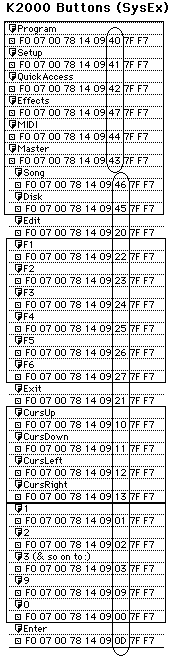
K2000 SysEx buttons
The above two files are the ones I use for
my K2000 synths. It was impossible
to learn the messages needed over SysEx to change
which tuning table was being used. Kurzweil didn't
even know. After discovering the secret via a long
and devious route, I made the first chart to
remind me. Turns out to be fairly straightforward.
If you use this excellent series of machines, and
want to try some of the other good tunings
available, this will make life easier. The second
chart shows how to "press keys" on the front panel
via MIDI. Both charts are in GIF format, and you
can yank copies of either one via your browsing
software and save. On my Macs I just drag the
screen image directly to the desktop for a quick
copy -- your machine may also support that
convenient feature.
MacWrite II Format or MacWrite 5 Format or MS Word Format or Plain TEXT (no formatting) versions: K2000-to-AIFF
Tip Sheet. You can also read it here from your browser. This is a description file
for K2000/2500 users who wish to edit their audio
files/sample on a Mac audio program.
I do this a lot, but kept
forgetting all the steps to use when I'd not done
it in a while. I've been a purist and kept the
SCSI connections for the Mac and K2000s
unconnected from each other. So I use floppies to
move the aiff format files back and forth. I
printed a couple of copies of this file onto thin
cardstock, and keep them handy when doing this
task. Much quicker than trying to find the
information in the manual. Give it a try.
MacWrite II Format or MacWrite 5 Format or MS Word Format versions: Alternate
Tuning Guide for the K1000, K2000, K2500, and FS 150
Synthesizers.
MacWrite II Format or MacWrite 5 Format or MS Word Format versions: Tuning
Table
for this guide.
And here is
the Examples
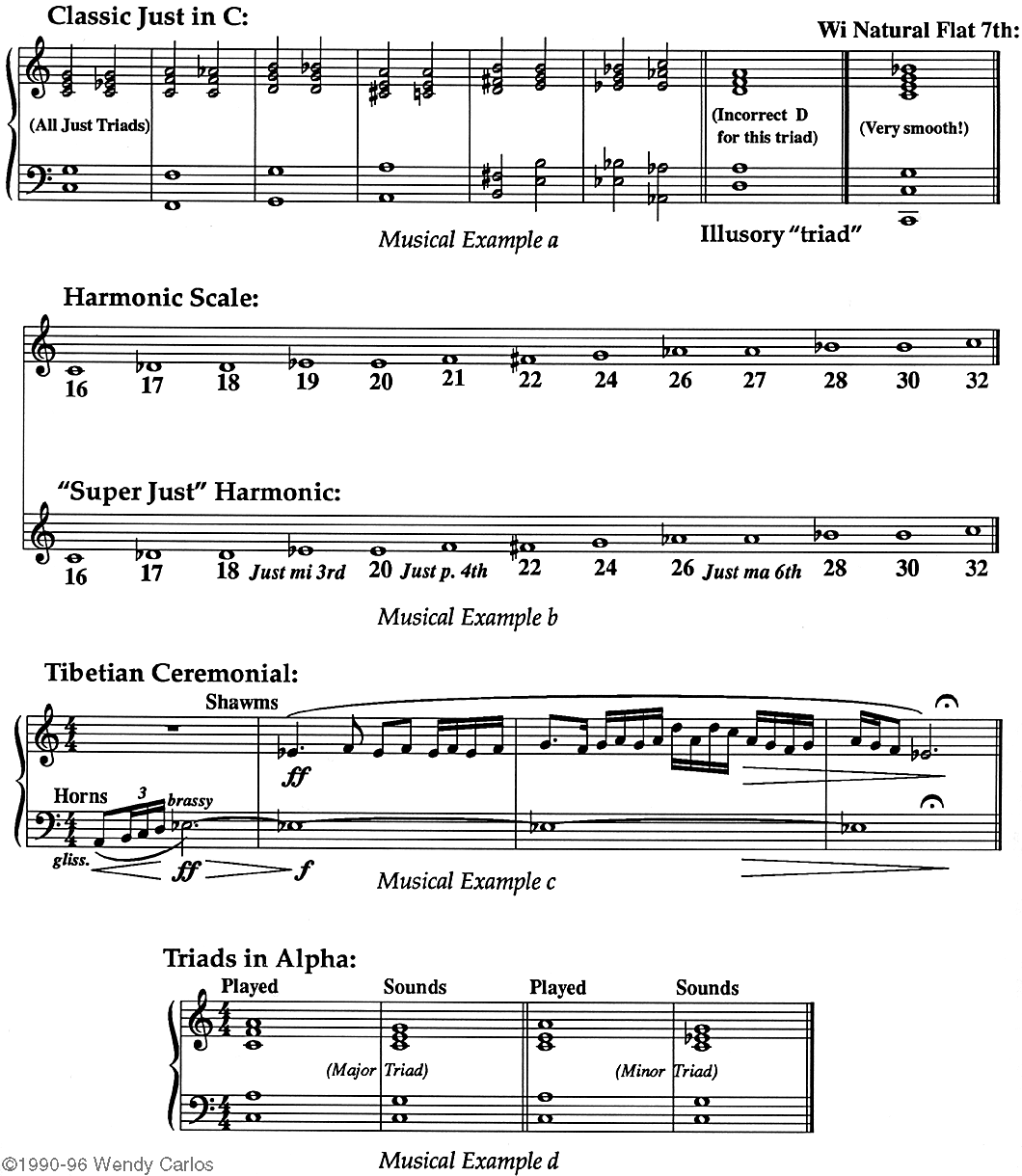
Page (in
GIF format) for this guide. It ought be printed or
viewed at 144 dpi "medium" resolution. Or you can
view it directly from your browser right here, but stand back, as you'll see it at
double-size on your 72 dpi monitor! (If you print it
from your browser, please change the Page Setup to a
size of 50% before printing, and after change it
back to normal. It should fit one 8.5" x 11" sheet
in portrait mode.)
This small guide book was written as a
present for many of my friends at Kurzweil several
years ago, and so is directed mainly to the K1000
series. But it's all very easy to use with the
newer units, as you'll see when you read it. And
it's easy enough to adapt to other brands of synth
as well.
Basically this
guide is also a mini-history of how some of these
fresh sounding alternatives to the standard
12-tone Equal Temperament came about, and how to
use them. The guide itself is available above in
several formats. Since the TEXT version can't
suppont all the formatting, nor the imbedded
images, I've not included it here.
Text

                        and illustrations ©1990-96 Wendy Carlos
MacWrite Pro Format or MacWrite 5 Format or MS Word Format or Plain TEXT (no formatting) versions: Three
Asymmetric Divisions of the Octave. You can also read it here from your browser. This is an article that
appeared in an issue of PITCH, published by the American
Festival of Microtonal Music.
Here's a short article I was commissioned to
write for this excellent journal of microtonal
resources. It's a non-general text explaining
Asymmetrical tunings, which I discovered in
1984-85. The three most important versions are
described, and suggested ways to use them is
given. Never before reprinted, this file is thanks
to Johnny Reinhard, who was able to locate copies
of the original files, thought lost.
Text

                        ©1989-96 Wendy Carlos
Here's a letter to the editor of the New York Times which I recently sent them.
It was in response to several articles in the Arts
and Leisure section of the Sunday Times which
brought up painful old memories studying composition
during the 60's. The articles were:
In Contemporary Music, a House Still Divided by K. Robert Schwartz
Letter (about the above article), by Charles Greenberg
Surviving the Seige, But Barely by Paul Griffiths
For copyright reasons
I can't place the original articles up on this
site, of course. It will probably be sufficient to
describe them to you in brief. The first article
described the world of contemporary serious
classical music as having been torn in two for
much of the 20th century. One side embraced the
Schoenberg methods of Serialism, and had major
influence on most of the music produced since at
least WW II: a consciously structured music that
deliberately avoided suggestions of tonal basis,
in any harmonic or melodic sense. Some serialists
also dissolved expectations of rhythm and meter
and structure.
If you ever
attended a concert of so-called "Modern Music",
you will know what it sounds like: astringent,
restrained and difficult to follow, even when you
know the system. It's mostly quite ugly
acoustically, and difficult to recall in any
detail as you leave the hall.
The other side
refused these notions, and so consisted
essentially of all other forms of serious music,
from the most conservative, to the most
experimental, as long as some tonality was
maintained, and the methods of the Serialists were
not. I was and still am a member of this latter
group.
The Serialists
often had a sneering or at least arrogant attitude
towards anyone who did not practice their
methodology. An outspoken example is the infamous
comment by Pierre Boulez:
Every musician who has not felt --
we do not say understood, but indeed felt --
the necessity of the Serial language is
USELESS."
It was rough to hear
such attitudes expressed, and subtler similar ones
of dismissal, and it grossly affected most of us
negatively, those of us who were on the other
side, like it or no.
The short
letter makes a point that some serial music was
not so deadening to hear, being based more on the
ideas of Bartok and Berg. While the second article
discusses ways that Serialism may be experiencing
pressures today not unlike the tearing down of the
Berlin Wall -- a newer generation that refuses to
go along with its well-worn methods, and is
striking out into more tonal and original
directions.
I try to cover
these ideas in my letter, including observations
of the personal difficulties of survival, being a
composition student in most music colleges and
universities during the heydays of rigid
serialism. Perhaps these pressures drove me and
many others since into the worlds of the
synthesizer and computer.
Text ©1997-2012
Wendy Carlos
|
(Top
of
the Page)
By
Popular Request
Downloadable Tuning Tables
DigiPerformer 1.6+/
Performer 5.1+ Format or Standard MIDI Format or .ZIP version of MIDI
format
and a PICT image (of the contents and
placement of the System Exclusive Data on the
tracks) for changing the tuning of several synths!
These are files that have been requested by
several of you who share my interest in
alternative tunings. Since it really is quite time
consuming to make custom tables for many synths,
here's a good starting place.
The sequencer
file (open one of the two versions for a look),
whose track layout is depicted in the PICT image
above, contains the tuning data I currently use on
the Yamaha TX802, the Yamaha
SY77,
and the Kurzweil K2000/2500 synths. Track one is just
a place-holding "conductor" track. Track two
contains the long System Exclusive message that
you can send to burn a Cartridge in the TX802
cartridge slot.
The cartridge
will then conveniently contain all tuning tables in this PICT image. You can just go into the
Performance Edit Menu, choose
"mtt#", and from there, in "PERF.EDIT6",
select the Micro Tuning Cartridge, with the number
chosen to match the desired tuning. Makes this one
of the easiest synths for using a lot of
alternative tunings, except that there is minimal
alpha support, so you have to refer to the tunings
by their number, not name.
The Yamaha SY77
is not so easy. I got a Korg
BL-1
(Boss Librarian for Sys Ex.), and with a small
MIDI merger box, it sits on the SY77's MIDI input.
When I need to change the tuning, I just power up
the BL-1, and then send its first file, which is
the Unlock Command. That's the message
stored in the above MIDI files on the 4th track.
(I copied it over to the BL-1's first SysEx slot.)
The tracks
below this are the tuning tables for 12 note
Equal, followed by the 12 keys of the Harmonic
Scale, the 12 of SuperJust, ditto for 1/4th comma
Meantone, and a few other interesting tunings
listed in the file and the PICT of the tracks. You
have to be sure your soundfiles access one of the
two RAM tuning tables (I use the 2nd one), and the
SysEx messages alter this RAM table. A bit
indirect, but that's how it has to be done. You
can also send the messages right from your
sequencer, even change them "on the fly" from
within compositions-- (Neat!)
The bottom
track contains the messages to send to change the
Kurzweil K2000 and K2500 synth tunings. These
units have all octaves internally set to 1200
cents. So the tuning tables only affect the
generic pitches, making all C's the same (except
for the octave), all E flats, F sharps, and so on.
This is truly convenient for many standard
tunings. But it is not flexible enough to use with
tunings that require more than one octave (12
notes), or have different tunings in each octave.
You just need to send the proper table to get the
tuning you desire, and then send one of the 12
lowest MIDI notes for the key you wish to play
that tuning in (or select this from the Master
Page of the unit.)
I hate to think
of how many hours it took to make these tables, or
even to locate the files, make these edited and
cleaned-up copies and images, double check their
contents, and then try to explain them a little
here for those of you who are interested. I'm
sorry that I can't instruct you completely what to
do to use the above files. I assume you already
have an idea -- a working knowledge of SysEx and
the use of sequencers and synth editing.
The first is in
Mark of the Unicorn's Performer (or Digital
Performer) usual format. The second is saved as a
standard type one MIDI file. You may have to refer
to the manuals for your given synth to work out
the other steps. Since many of you already know
how to do it, these files could be of genuine help
to you. Good luck with them, and enjoy hearing
what we've been missing for far too many years!
--Wendy
|
(Top
of
the Page)
|
Funny
Bones
A sign over a fireplace mantle in New Hampshire
has this puzzle on it. I saw it in a charming old
Inn while having dinner with friends in the late
'70's, and it caught my eye. The last line seemed
clear enough, but how about the rest?
|
If the BMT put more :
If the B . putting :
Never put more : over a - der
You'd be an * it
|
So I scribbled it
down, and when I got home tried to figure it out.
Turned out that the terminology was kind of
archaic, but then it was a puzzle from some
word-playing "Yankee" made up over a hundred years
ago. At first it's harder than it looks.
Eventually it dawns on you what it's all about.
Simple stuff, and kind of corny, too. Think of
where the sign is located, near the grate of a
roaring fireplace, where strangers might have
helped out fueling the flames-- IF
they knew their English!
I suppose this
is a ridiculous thing to put up here, especially
since I'm not giving the answer ("Ooo -- she's
mean, that one!"). Quite a few of our friends have
doped it out, though, and once you do, you can
spring it on the boastful "puzzle solvers" in your
group. Hang it on the wall, smile, and then be
prepared to duck...!
Postus Scriptuswise: It seems that
the Gold Leaf awards (for the sole Moog note in S-OB 2K) located at the
top of the currently most recent Open Letter have inspired a loyal fan
to solve this word-play puzzle, and to send me his
solution. His sole "fluff" was so inconsequential,
one word, and his spirited solution was so much
fun to read, I thought I'd add his name here, with
a special Neo-Gold Leaf.
 So CONGRATULATIONS to Todd M. Curro, who
gives as his addresses, Massachusetts and South
Korea. You're the first person to have done this,
too -- plenty of reason to add your name right
here, hey! So CONGRATULATIONS to Todd M. Curro, who
gives as his addresses, Massachusetts and South
Korea. You're the first person to have done this,
too -- plenty of reason to add your name right
here, hey!
And another CONGRATULATIONS to Ian Kemmish, who lives
in England. I never planned on this small section
of the Resource Page to contain another contest
(like the one Moog note one, which always appears
at the top of the newest Open Letter).
But upon seeing
the first listing above, which I posted more out
of a jocular sense, Ian responded in like manner.
I guess we'll post his name, too, as he nailed it
easily and completely accurately. I suspect that
those with a British background might be more
familiar with some mildly out-of-date language
terms once commonly used in "The Colonies", too.
However, American English, while related, has
become a "hole-nuther matter" (and every bit as
slangy as those two citrus fruits and Bells of St.
Clemens...)
And now let's
end this amusing aside with three final Neo-Gold
Leafs, acknowledgments for solving this venerable
old New England challenge. Since it's not mine,
and I never intended this web-bagatelle to be
treated so seriously, like the musical challenge
of the one Moog synth note on
SOB 2000,
I won't promise to continue to add names of those
who enjoy the kick of solving a venerable word
puzzle. But, hey, you never know...
Anyway, sans further ado,
here are three additional Neo-Gold Leaf CONGRATULATIONS which we extend to the
following bright people:
TMike Stubbs & Zack Turpin of
"wavingpalms", Peter Holliday (who has been an
interesting music correspondent, too), and David
Harris, another savvy solver from the UK. All of
you got the exact (or for Stubbs and Turpin, a
very nearly exact) translation, good work!
Recently a good friend was
enthusiastically about to commence his first
professional set of recording sessions (you know who
you are...!) In my usual helpful, supportive, but
ever malicious way, I decided to jot down a series
of "Helpful Tips for the Novice Recording Engineer",
and send it to him. With tongue firmly in cheek,
here is the nasty parody that resulted.
-- Recording Tips -- For
the Beginner --
(Caution:
all of the advice in the above "tips" is as
untrue as this warning statement about it.
Read at your own risk! --the management )
Note: For some reason,
this satire has been picked up by many others in
the recording arts and sciences who have sent it
out to friends on the Net. So you may have
encountered a version of it before. The text here
is the official authenticated version, after all
final polishings, revisions and additions were
made. (Big deal...)
Text for Recording Tips ©1997
Wendy Carlos
Rest of this page updated and ©2012
Serendip LLC -- All Rights Reserved
|
(Top
of
the Page)
Interesting
Miscellany
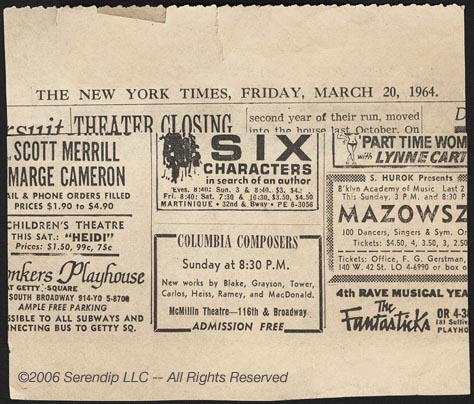
While searching through an
old file cabinet for some Moog information sheets
to post on our site, I also discovered a tiny
newspaper clipping from my days at Columbia
University, as a graduate student in the Music
Department. That's where I met Vladimir
Ussachevsky, the electroacoustic music pioneer, as
well as other notable professors, like composers
Jack Beeson and Otto Luening. For years the music
department organized free concerts of music
written by student composers in the department,
and they called them: "The Columbia Composers."
This series had faded away by the time I arrived
in the early 60s. In it's place were several other
concert series of new music. Alas, the only place
for the graduate student composer was within the
new program by "The Group For Contemporary Music
at Columbia University." They seemed to offer ONLY
dodecaphonic, or serial, atonal fare, and other
quite severe, generally ugly styles.
That was not
for me, and contrariwise, those of us who tried to
find other less restrictive musical styles and
genres were not what the new group wanted to play,
either. A standoff. So several other composer
friends and I decided to restart the earlier
Columbia Composers program. For the three years I
attended, we presented new music in a broad
selection of styles and media, and carried on the
earlier tradition the best we could. We rented
McMillin Theater (now Miller), designed and
printed our own programs (we'd cart our master
sheets down to ERS offset printers downtown), much
as amateur performers have always managed. I still
have nostalgic thoughts about some of those
concerts experiences...! Fortunately, despite all
the moves since then, I had managed to save one of
the small ads we placed in the New York Times a
week before one of our concerts (this one was in
March of 1964). We had nearly no budget, so it had
to be tiny and to the point. Here's a decent scan
of the clipping:

(click
for full size image)
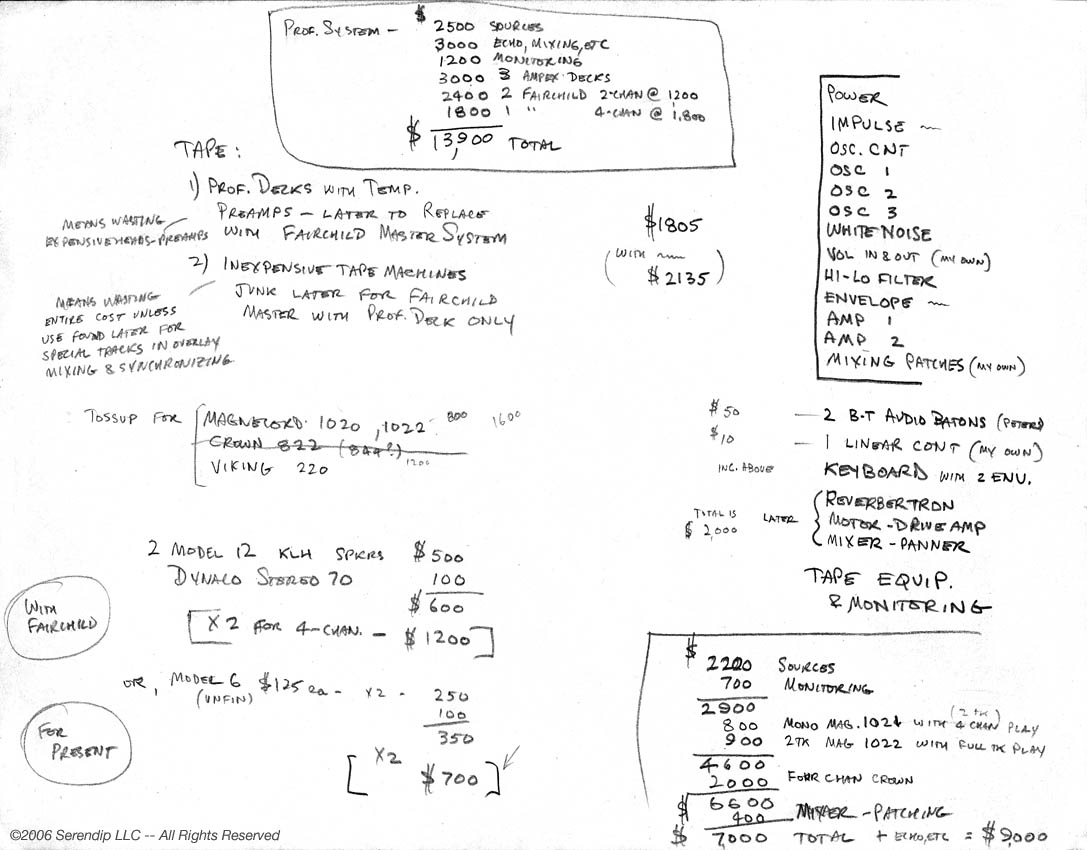
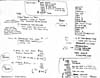
Mixed in with the clipping
above, I also found this single sheet with my
scrawled figures of what it would cost to build a
small new studio. It dates from somewhat over a year
after that clipping, when I had finally graduated. I
considered trying to set up a few new devices on my
own, much like Ussachevsky's small McMillin Room
#106, where I had done most of my electroacoustic
composing while studying for my MA. Perhaps I could
collect and hand-wire some equipment slowly for my
new studio apartment, while I continued to work as
an audio engineer for Gotham Recording Corp. on West
46th Street.
I knew of no Moog
Synthesizers (I was just about to meet Bob), or any
other kind, either (save the huge racks of the RCA
Synthesizer up on 125th Street, which was mostly
used by Milton Babbitt). There WERE some kit
versions of electronic organs (by Schober and
Artisan, for example), which might be modified to
create interesting non-organ sounds. There were also
the usual test oscillators and tape recording studio
devices which would prove essential. Fairchild had
been developing an interesting new multitrack tape
recorder (their "Master System") which had very good
specs, and used narrower tape than usual for Ampex
and Scully, which would save money. But that line
never worked well. It took a few years before the
quite pro home studio you see in the photos section came to be. But this small
sheet (goodness, look at the modest prices back
then! But then salaries were equally diminutive...
and this was far from "small change") suggests that the path to
that setup I created S-OB on was in no way
"immediately obvious"!:
(click
for full size image)
Only 3-4 years later, my
small first home studio was taking shape. You can
see what it looked like here, just after completing
S-OB. The bulky tape machine (with a tall table lamp
up on top) is the Ampex 8-track tape recorder I
cobbled together from many parts. Its story is told
in many other places, I won't repeat it here (the Switched-On
Boxed Set
contains the most extensive descriptions, with
plenty of photos, of my various studios and
equipment, within the included two CD "booklets"
(hard to call something a half-inch thick a booklet...!)
Down below the
first three Ampex preamplifiers you can make out two
smaller rack panels. The lowest one is a very simple
passive mixer, which allows one to hear any blend of
the tracks while overdubbing, with no need of a
console. Just above that is a homemade Sel-Sync
panel. That's Ampex's term for a box included on
most of their multitrack tape machines which lets
the engineer use the record head, instead of the
normal playback head, to hear existing tracks, while
the new overdub recordings are made. Being all in
the same place along the tape, this allows the
performer to record the new parts in exact
synchronization with the already recorded tracks,
thus the name.
But Ampex had
very few 8-track Sel Sync boxes in the mid-late 60s,
and they were hard to get and very expensive. I knew
I could build something that would work about as
well, and did so. A professionally engraved front
panel makes it look surprisingly pro. The parts were
bought in town, as was the custom ordered stacked
8-track head assembly from IEM. For transforming the
record head's outputs into something more resembling
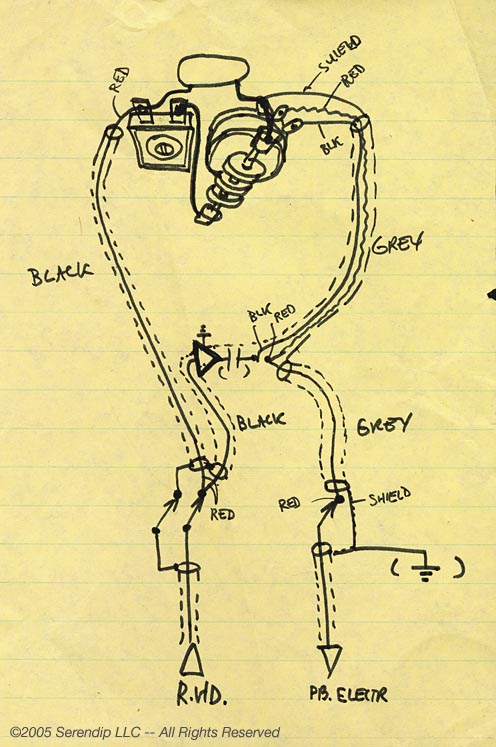
a PB head's signal (also filtering
off any tape-bias leakage), I was going to use a tiny
transistor preamp for each track. Here's the first
draft idea, before getting some advice from Bob
Moog. Sadly, the final prototype created more
problems with noise than it solved, so I ended up
with a passive circuit, which had no gain but added
no hiss or hum, either. With that you had to
readjust the playback level control for each
Sel-Synced track, turn them back for normal PB, that
was the tradeoff. This small hand-drawn schematic on
yellow paper from a legal pad is all that's left of
a reasonable idea that didn't work out.
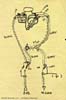
(click
for full size image)
Dvorak Keyboard Layout (KCHR resource for
Macs)
I've been using the Dvorak Keyboard layout
since 1986. It was a surprise when Apple, who
originally had made the simplified keyboard a mere
button press on the Apple IIe, IIc and IIc+
abandoned it on the Mac. But with ResEdit and
Fedit, I discovered where the "asdf..." table was
located in the system, and carefully changed it to
the Dvorak configuration.
It was a mere
two weeks to learn the new positions, many months
less than it was to learn qwerty years ago. And
over the next three weeks I got back to my
original speed, and quickly surpassed it. My typos
went down, and the fatigue of long typing sessions
vanished. When I must, I can still use the clumsy
old standard, no problem. All those silly rumours
of how hard it is to change are pure fabrications.
You'll see. Have people never heard of carpal
fatigue syndrome? Do yourself a favor...
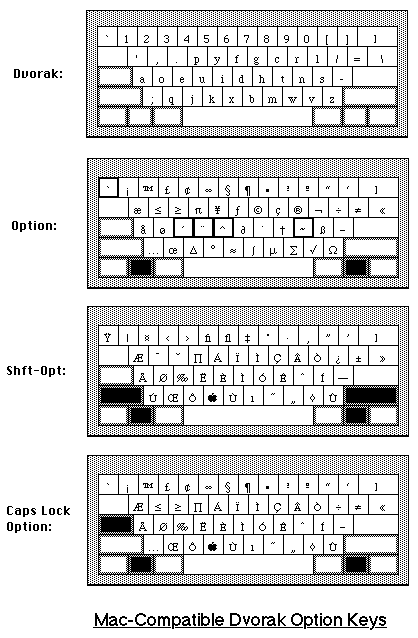
If you'd like
to see what this ANSI Standard layout of keys is like,
take a look at this image of your typing keys,
including what you'll get when the "modifier" keys
are also pressed. (You might print this chart for
a reference, too.)
One neat trick
is to use press-on letters on the keytops, then
put a couple of coats of clear nail enamel over
them, buffed with fine steel wool (most keyboards
have different angles for the tops of keys on each
row, so you can't just move them around to a new
layout, or it looks messy). I've also seen
adhesive key tops in thin plastic with the
appropriate letterings.
Originally each
new Mac System update had to be edited to change
the keyboard layout. But with the Mac's System 7,
it became a lot easier to install Dvorak.
You need only an appropriate KCHR resource. (It's
similar for Windows machines.) So I hacked the
US-qwerty KCHR resource so all the shift and
option combinations matched consistently, and this
is the one I now use. (Double-click open the
System itself, drag this KCHR inside, and close.
Then select Dvorak from the Keyboard Control
Panel.) You may want to give it a try. Very
recommended!
©
1998-2012 Serendip LLC. No images, text, graphics
or design
may be reproduced without permission. All Rights
Reserved.
|
(Top
of the Page)
 Back to the Wendy Carlos Home Page